

One patient, one record, across every branch of the Hospital or chain.
The Hospital module is a Hospital information system for one Hospital or a whole chain. Registration, appointments, outpatient care, wards and beds, laboratory, radiology, pharmacy, billing and insurance all work from the same patient record, and the safety checks cannot be skipped.
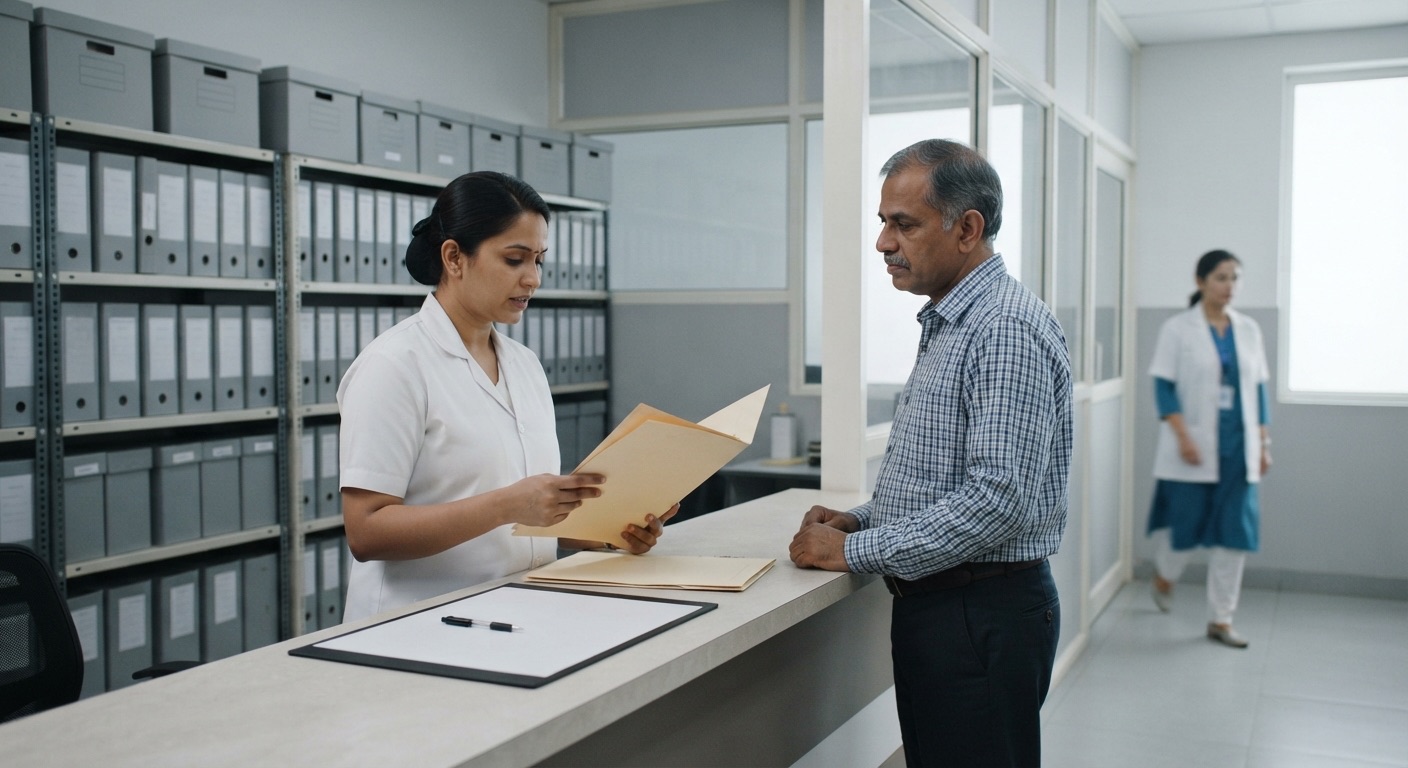
Patient, registered at Branch 1
A patient's path through the Hospital, from the front desk to discharge.
Each stage works from the record made at the stage before it. Nothing has to be copied from one department to the next.
Register
One patient number, duplicates caught before a second record is made.
Consult
The doctor records the visit, diagnosis and allergies on the Hospital's own forms.
Tests
Orders go to the lab and radiology, and each result stays open until it is read.
Admission
A bed is given from the live bed board, with nursing care recorded.
Billing
An estimate before treatment, then deposits, interim bills and the final bill.
Discharge
The summary and records are signed, and statutory registers are updated.
Every part of Hospital work, from the front desk to the discharge.
Each block below covers one part of the module. Together they keep one patient record for every branch and every department.
A patient is registered once, and the same number works at every branch of the chain.
The front desk registers a patient once. Duplicates are caught by name, date of birth, phone and ID, and insurance and government scheme numbers are captured at the same time. A QR patient card can be used at any branch.
- One patient record for the whole chain, with a patient number that works at every branch.
- Duplicate detection at registration.
- Insurance and scheme numbers captured at registration, including PM‑JAY, ESIC, CGHS and Corporate schemes.
- A QR patient card, and personal details kept encrypted.

Registration, Branch 1

Consultation, Dr. on duty
The doctor records the visit, and every safety alert must be seen and answered before a prescription goes through.
The doctor records the visit on the Hospital's own forms, notes diagnoses as proper medical codes, and writes allergies down. Drug interaction and allergy alerts must be answered before the prescription can be issued, and an allergy that was not asked about is never shown as none.
- The Hospital's own clinical forms, versioned, with visits and vital signs.
- Diagnoses as proper medical codes, and triage on the Hospital's own scale.
- Prescriptions with safety alerts: drug interactions and allergies, each answered before it goes through.
- A formulary showing which drugs the chain allows, and where.
A lab result that nobody has read stays open, so no result is lost in a queue.
Samples are tracked from collection through processing to the result, with quality-control evidence for each period. A result stays open until a doctor reads it, and radiology reports and images are kept with the same record.
- Sample collection, processing, results and reports, with quality-control evidence.
- Results tracked until a doctor reads them.
- Scan orders, scheduling, reports and images, with licence tracking for radiation equipment.

Sample, blood panel

Ward, bed board
The bed board shows every bed across the Hospital, and nursing care is recorded as it is given.
Admission, transfer and discharge are handled from one bed board for the whole Hospital. Nurses record vital signs, early‑warning scores and the medicines given, so the next shift sees what the last one did.
- Admission, transfer and discharge, with a live bed board for the whole Hospital.
- Care units show where each patient physically is.
- Nursing care and medicines given, with vital signs and early‑warning scores.
An estimate is given before treatment, and every rupee is billed to the right payer.
Each service is priced from the Hospital's rate list. Packages cover a whole episode of care, and the estimate is updated when the plan changes. Insurance, TPA, Corporate and government schemes are billed to the payer who covers the patient.
- A charge master and rate plans, with prices that can differ by facility.
- Packages for a whole episode of care, with each part charged once.
- Estimates before treatment, updated when the plan changes.
- Deposits, interim bills during a stay, and the final bill, with bill corrections only by authorised people.
- Payers: insurance, TPA, Corporate tie-ups and government schemes, with claims made.

Estimate, knee replacement

Pharmacy, dispensing
The pharmacy dispenses from the same stock and records that the medicine was given.
Pharmacy dispensing and stock run through the platform's stores and inventory. The medicine given is recorded on the patient's own record, so the chain can see what was dispensed at any branch.
- Pharmacy dispensing and stock, through the platform's stores and inventory.
- Medicines given recorded on the patient's record.
Statutory records and every look at a patient's record are kept, and the Hospital keeps working when the network does not.
Deaths, notifiable diseases, prenatal scans and radiation equipment licences are recorded in the statutory registers. Clinical documents are signed digitally, every look at a record is logged, and a downtime mode keeps the Hospital working during an outage.
- Deaths and notifiable diseases reported to public health, and prenatal scan (PCPNDT) records.
- Clinical documents with digital signatures, and every look at a patient's record recorded.
- A downtime mode, with everything recorded during an outage saved afterwards.
Statutory and safety
What sets the module apart from a single‑desk system.
Each of these is part of the module itself.
- One patient, one record, every branch. Built for chains from the start.
- Safety by design. Alerts cannot be skipped, unread results stay open, and allergies are never assumed.
- Price before care. Estimates and packages are clear to the patient before treatment begins.
- Compliance built in. Statutory registers, licences and audit trails.
- Part of a full ERP. HR, payroll, accounts and purchasing are already there.
The Hospital module is connected to the people, the money and the stores.
The Hospital's staff, bills and supplies come from the same platform as the rest of the institution.
Built for the desk, the wards, the labs, the billing team and the chain's management.
Each role sees the part of the Hospital's work that belongs to it.
Front-desk and registration staff
Register patients, book appointments and issue queue tokens.
You want one record per patient, found in seconds.
Doctors
Consult, write notes, diagnose, order tests, prescribe and refer.
You want every alert and every result in front of you.
Nurses
Triage, record vital signs, give medicines and manage the ward.
You want the next shift to know exactly what was done.
Laboratory, radiology and pharmacy staff
Collect samples, run tests, report results, and dispense and manage stock.
You want every order to reach you and every result to reach a doctor.
Billing, insurance and TPA desk staff
Prepare estimates and deposits, bills and claims.
You want each bill sent to the right payer the first time.
Admission and bed management staff
Admit, transfer and discharge patients, and run the bed board.
You want to see every free bed in the Hospital at a glance.
Medical records, quality and compliance teams
Keep records, statutory registers and quality evidence.
You want every register complete when the inspector asks.
Hospital or chain management
Watch dashboards across every branch.
You want every branch on one screen.
Questions people ask about the Hospital module.
Is the Hospital module for one Hospital or a chain?
Both. It serves a single Hospital, nursing home or clinic, a chain of Hospitals and clinics owned by one group, and Hospitals run by Universities and medical Colleges. Each Hospital, clinic, collection centre or pharmacy is a facility inside the owner's account.
Does a patient get one record across the whole chain?
Yes. A patient is registered once, and one patient number works at every branch. Duplicates are caught at registration by name, date of birth, phone and ID.
Can a drug alert be skipped?
No. Drug interaction and allergy alerts must be seen and answered by the doctor before the prescription can go through.
What happens to a lab result nobody has read?
It stays open until a doctor reads it, so no result is lost in a queue.
Does it handle insurance and government schemes?
Yes. Insurance, TPA, Corporate tie-ups and government schemes such as PM‑JAY, ESIC and CGHS are captured at registration, and bills are sent to the right payer, with estimates given before treatment.
What happens if the internet goes down?
A downtime mode keeps the Hospital working during an outage, and everything recorded in that time is saved into the record afterwards.